
By Tyson Dirksen, Evolve Development
Abstract
Traditional real estate development often prioritizes first cost over long-term performance. High-performance buildings, designed with airtight assemblies, mass timber, triple glazing, and dedicated ventilation systems, consistently outperform conventional assets in rents, sale prices, cap rates, tenant retention, and operational savings.
Verification through engineering documentation, construction photos, commissioning, and third-party building scientist sign-off ensures that these benefits endure, effectively acting as a building-level warranty. This approach secures the foundational Maslow “building triangle”, enabling higher-order value—luxury finishes, tenant experience, and market appeal—to persist over decades.
1. Introduction: A Value-Driven Approach to Longevity
High-performance buildings must first satisfy shelter, comfort, and safety before delivering higher-order aesthetic or luxury value. This mirrors Maslow’s hierarchy of needs, a pyramid of human priorities:
-
Physiological needs – shelter, water, air, and comfort
-
Safety needs – protection from harm, environmental security
-
Love & belonging – social connection, community
-
Esteem – recognition, achievement
-
Self-actualization – fulfillment, creativity, purpose
In building terms:
-
Base: airtight, waterproof envelope, structurally robust
-
Middle: mechanical efficiency, ventilation, thermal and acoustic comfort
-
Top: finishes, brand, views, design prestige
Just as humans cannot achieve self-actualization without the base levels, buildings cannot deliver long-term value, tenant satisfaction, or luxury appeal without a secure foundation. Many buyers overvalue finishes and overlook the base, only to encounter costly failures later—water intrusion, mold, or mechanical issues—that erode asset value and operational performance.
2. High-Performance Envelope: Mitigating Water and Air Risk
A high-performance envelope addresses the two greatest sources of building risk:
-
Water intrusion and moisture damage
-
Air leakage and energy loss
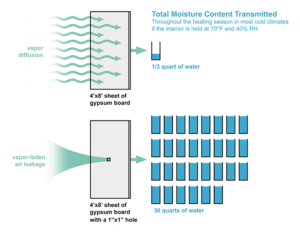
Building Science Corporation demonstrates that during a heating season, air leakage through a 1-inch hole transmits ~90× more water than vapor diffusion through a 4’×8’ gypsum panel¹. Infiltration drives heat loss, condensation, and potential mold, threatening structure and occupant health.
Critical systems include:
-
Fluid-applied or peel-and-stick waterproofing that self-seals around penetrations
-
Tight air barriers integrated with high-R wall assemblies
-
Triple-glazed, thermally-broken windows for energy efficiency, noise reduction, and condensation control
-
Mass timber or robust structural systems
-
Dedicated ventilation with filtration and energy recovery
Verified installation ensures durable, predictable performance over decades.
3. Certification and Verification: Securing the Building Base
The building’s foundation cannot be assumed. Every system should be validated and documented to preserve value and reduce risk:
-
Architectural, structural, mechanical, and civil engineering details
-
Construction photos and installation documentation, especially at connections and critical transitions
-
Commissioning and performance testing for all systems, including waterproofing, air barriers, and mechanical equipment
-
Third-party sign-off by building scientists or envelope specialists
This certification should remain with the building for its entire life, like a high-performance car warranty. Benefits include:
-
Securing the Maslow building base (shelter and comfort)
-
Reducing long-term risk and unexpected costs
-
Protecting occupant health, safety, and well-being
-
Preserving financial and operational value, supporting higher rents, sales prices, and cap rate compression
Certification ensures that upper-order value—luxury finishes, design prestige, and tenant experience—can be delivered without hidden failures.
4. Quantifying Financial Value
4.1 Rents and Sale Prices
High-performance buildings deliver measurable financial premiums:
-
Healthy building certifications: 4.4–7.7% higher effective rents²
-
BREEAM-certified properties: 6–8% higher rents, 14–16% higher sale prices, in some markets up to 20% rent premium⁴
-
Productivity gains from superior indoor environmental quality: $50/ft² per year, or $20,000+ net value per employee annually³
These premiums directly enhance NOI, increasing asset value.
4.2 Cap Rates and Investment Risk
Investors price risk into cap rates:
-
Certified high-performance buildings often show 40–80 basis points lower cap rates²,⁵
-
Lower risk stems from predictable income, durability, and regulatory resilience
-
Verified systems and third-party certification reduce perceived investment risk, increasing liquidity and market demand
Lower cap rates translate into higher valuations and more favorable financing.
4.3 Operational and Health Benefits
Operational efficiency and health-focused design provide additional value:
-
Energy efficiency reduces utility costs by **20–60%**⁶
-
Improved ventilation and lighting support $38B annual U.S. economic benefit and $200B in productivity gains, with **cognitive performance improvements up to 101%**⁸
-
Over a decade, health and productivity benefits can exceed $2M NPV per building, far surpassing direct energy savings²
These benefits reinforce tenant retention and stable cash flow, key to investor confidence.
5. Conclusion: Performance as Investment
High-performance mid-rise buildings with 500-year design intent are strategic investments:
-
Capture higher rents and sale prices
-
Achieve lower cap rates and reduced risk
-
Deliver operational savings
-
Provide quantifiable health and productivity returns
Verified design, construction, and third-party certification ensure these benefits endure, protecting occupants and investors alike. Luxury finishes and tenant experience matter—but only atop a verified, durable base that secures the building’s long-term performance.
Footnotes
-
Building Science Corporation, 2020. Moisture transport via air leakage vs vapor diffusion in cold climates.
-
ASHB/Healthy Buildings Research, 2020. Rent premium data for healthy building certifications.
-
International WELL Building Institute, 2025. Productivity gains from improved indoor environmental quality.
-
BREEAM, 2023. Certified building rent and capital value premiums.
-
Knight Frank, 2021. Cap rate compression in certified sustainable buildings.
-
U.S. Department of Energy, 2023. Energy savings in high-performance commercial buildings.
-
International Energy Agency, 2022. Operational cost reductions through efficiency.
-
WELL Building Standard Economic Analysis, 2023. Productivity and cognitive performance benefits.
7 Responses